Friday, June 05, 2009

sathya on Inquality and human values

Whenever I used to contemplate about the “economic imbalance” in society, i.e. many are poor, whereas a few are rich, it always occurred to me that lack of Human Values is the fundamental problem. And I used the oft-quoted paradigm of “IT industry pays best than rest” to conceptualize this.

To illustrate this, let us take a case study of a super market. Let us describe the services / transactions / stakeholders in a diagram as follows (sorry about the pathetic arrows!).

Your browser may not support display of this image. Your browser may not support display of this image.

As all of us know, supermarket never manufactures things. Assume a poor farmer producing rice/ wheat / vegetables / fruits supplying for this supermarket. If the base amount he would get for producing the commodity is ‘x’, the supplier (whose job is relatively simpler than farmer) gets at least ‘3x’, and the supermarket would sell the product with an equal or more profit. And there are customers, who are ready to pay this figure!

Let us go back to diagram. People do not mind paying 2 rupees for an item, while they could get an equal / slightly low-quality item for Re. 1. Many of them buy things which they would seldom / sparingly use. And the supermarkets price the products based on these “strategies”. Thus, rich people continue to become richer.

Of course, one may argue that it is the so-called “knowledge” which makes people rich (software guys are, after all, smart!!). I have come across many of these so-called “know ledged” whose whole intention is to “Live and Let Die”. They do not hesitate to trample others for their well being. The poor, for the simple reason that they are less / illiterate, inspite of their hard work, remain poor.

A little thought would reveal that if only we practice, what Sathya Sai Baba calls, “Ceiling on Desires”, i.e. putting a stringent limit on our otherwise uncontrolled desires, having a little “discrimination” (what we really need / what we do not), and sharing of wealth (giving back to society from where we got riches), would equalize / balance the economy.

Friday, January 16, 2009

Ethics in marketing and Advertising

What Do Marketers do:

Finding what the customer wants and creating an perceived value(illusion/real) that he is getting it by buying your product is in essence marketing.

That is exactly what Marketers do to conquer potential customers mind spaces and attention keep you in their spells of perceptive value, influence decision to buy and there by makes money(more value compared to the cost)

The fundamentals: The world we see is our Perception; may not be Real.

The fundamentals to life is the urge to survive and then live, when we say somebody is full of life what we are saying is that, they are enjoying all the little pleasures of life and living in the present, having the nostalgia of the past and dreams for the future. Human life that we are so concerned is extremely short/ephemeral 60-70 years compared to the global scale of things(say life of trees, life of mountain, life of river, life of start etc..).. when the cosmos looks at us, we are like a water bubble's life compared to human life(The vedas says this).

Life itself could be a big illusion.. only thing that amazes me is our ability to phantom/understand this. Unable to understand how we are able to understand most things given time and focus.

Coming back to the point marketers are not at fault in seeking way to capture of our attention.. because it is their business to create illusion to sell things for filling up their stomachs..and feed their minds with illusions themselves.

So it is for us to be in awareness. and choose what we buy and not to succumb to the spells that these marketers create to trap us in our fundamental weakness in life Sensual pleasures and fear of uncertainity(INSURANCE- BEWARE THESE GUYS).
If people are not aware, that is not the fault of the marketer


Ideally I don't believe in artificial regulations.. honestly.. it only works to an extend.. self regulation is best form of regulation and most ideal. But we live in a practical world of Notions of ethics(personal ethics, family ethics, caste(occuption) ethics, societal ethics, Religion(path to god), ecological ethics,

Ethics are important for an apparent balanced world, if we think we want to have apparent control over it. So lets be in AWARENESS of Truth and experience the BLISS that is essence of SAT-CHIT-ANANDHA

Ps: -
MARK "APPARENT".. everything is apparent except ourselves.
MARK "Notion" All good and bad is based on our Notions which is based on our samskaras(PAST ACTIONS
)

Sunday, May 20, 2007

sathya on human values

Human values

At the outset, I wonder the situation that has prompted somebody to create a "blogspot" for "Human Values" as if they are something distinct and different from us! It sounds as though, were fishes use some discussion group, would they discuss about swimming!! Anyway, that is the great comedown, the ground reality for us, the humans.

As for "propagating" / "creating awareness" of these values, I firmly believe that only by living them, you serve as the best example. We have enough scriptures, codes of conduct, etc. as to how to lead life, but it seems we loose ourselves in mere intellectual lexicalization and fail to understand the sublimate stuff. As Sri Sathya Sai Baba says, these human values can never be got from outside i.e. from books, shops, etc. but are something inherent in us. Some techniques, as given by Him are really helpful in adhering to these human values. The first thing is: Follow your Conscience. This Conscience is something wonderful which all of us possess and the most precious gift that one can have from God (and it is the one often being discarded!).The difference between a thief and one who is not is that while the thief knows theft is bad, yet unable to obey his Conscience, the non-stealer implicitly obeys his Conscience. A very simple example to show where the root of our value system is. And this our Conscience is often clouded by limitless desires. It is often our experience that when we long stop listening to Conscience, it will stop speaking to us.

The second thing is: Integrity (Harmony) in thought, word and deed. The results are amazing if only we make sure that we think only good thoughts and decide to speak only them and put into action what we speak. It is really a very practical solution; try this for sometime. You will know it for yourself.

Gone is gone, at least, if we want the coming generation to preserve the validity of human beings, it becomes our utmost responsibility to see that our children do not get into this mad, material race, chasing after nothings. All the so-called valuables, gold, diamond, currency etc. are given value by US (humans) and apart from that, they DO NOT have any independent value. Thus, if we want to revalue the human values, we necessarily have to devalue these "precious" commodities. These truths must be imparted to the younger generation and it is parents' utmost responsibility to ensure that a being "good" man is as important, if not greater, as being "great" man.

Sunday, February 27, 2005

What the hell is this?

I found this as a forward, and I thought it would be appropriate to put it up here.

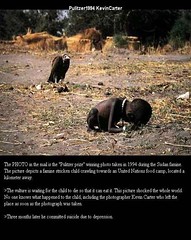
The photo is the Pulitzer Prize winning photo taken in 1994 during the Sudan famine. The picture shows a famine stricken crawling towards a UN food camp located a kilometer away. The vulture is waiting for the child to die so that it can eat it. This picture shocked the whole world. No one knows what happened to the child, including the photographer Kevin Carter who left the place as soon as the photograph was taken. Three months later he commited suicide due to depression.


This is what the Kevin Carter wrote:

Dear God,

I promise I will never waste my food no matter how bad it can taste and how full I may be. I pray that He will protect this little boy, guide and deliver him away from his misery. I pray that we will be more sensitive towards the world around us and not be blinded by our own selfish nature and interests.

I hope this picture will always serve as a reminder to us that how fortunate we are and that we must never ever take things for granted.


Just two points I want to make:

  • What kind of ethics do photojournalists have?
  • Why the hell did this photo win the Pulitzer Prize? He should not have been awarded the prize, since he lacked any sense of ethics.


Monday, February 21, 2005

Education

There are two aspects to education: 1. Imparting Knowledge. 2. Instilling character.

It is an age old saying that "If character is lost, evertything is lost". Nobody says "if knowledge is lost, everything is lost". Today, education has become synonymous with gaining more and more knowledge, be it theoretical or practical. This section itself is not very good. What is happening is that the character side of education is facing severe neglect, mainly because the teachers themselves lack them. In the case of knowledge, even if the teacher is dumb, students have other sources like books, internet etc. But for character, the sources of learning for a child are parents and teachers. A parent/teacher of a great character can produce students of great character, even against the so-called peer pressure, because in those cases, peer pressure reduces due to the overwhelming influence of the teacher/parent. Sad part is neither the parent nor the teacher have that character. Where from are you going to select good teachers in this regard?

If you think about it deeply, the philosophy of education itself needs to be modified to not just produce great engineers and doctors, but to produce, basically a good human being who has heart, and not machines that work only for themselves. The present system only leads to the formation of such machines. Unless something is done about it soon, the world will surely be ruled by robots - robots who have flesh around their bones and blood running through their veins. Sooner we act, the better it is.

But the age old question remains: Who will bell the cat?

keep the focus on the goal and move on!

Inter-faith talks are organised by different organisations, i attended one recently.
religious leaders from the various faiths of hinduism,chirstianity,islam,buddism and jainism gave talks, i really really did not see any difference in the way the books treated life on earth and how humans have to live on earth.

The differences come only about life before birth, or life after death. which actually nobody has a real clue about!. while these are important things that man has an unconscious desire to ponder. These are pretty personal questions i believe. nothing can actually truly convince us in this regard, it could at the max be Intellecturally and Emotionally stimulating. Atleast this is my experience, interms of trying to believe something. how can you ever believe anything on earth which is changing all the time. anything can decieve you. (if you don't believe this,shoot a question i can tell how?)

so i don't understand why these religious fights came in today today life. biggest of wars spots are kashimir(hindu * muslim) and palestine(muslim* christian) and potential spots for a 3rd world war.

Material things are associated with spirituality. when rituals are given more importance than understanding the truth. if only we can think for a minute, and ask ourselves "how does it matter?" you will get a resounding "it doesn't matter"

there 2 objectives

1 - To live peacefulling in this world- for which all religions precribe almost the same rules
2 - To understand the truth- which pretty individualistic and personal, where no one can really tell this is the truth.

so religions and difference is truely a figment created because of associations and rituals rather than by any fundamental difference. It is myopic vision of ritualistic people that is causing narrow mindedness that we see.

we are all humans, and we all want to realise or find the truth (if it exists). so no point in fighting over non-entities! why get distracted!

keep focus on the goals and move on towards it!

Tuesday, January 18, 2005

Of Wastage and Accumulation

I just noticed a couple of days back that humanity has two peculiar, and contradicting tendencies. This idea struck me when I got up early in the morning and made my way into the bathroom. One of the taps was open and water was flowing out, no one to care.

On one side, we are big wasters. We waste every possible resource available to us. I have seen a million times how water simply runs out of a tap. Carelessness is the reason. Worse, if water runs out right in front of our eyes, and we do nothing about it. Just see for yourself next time you wash your face. Odds are that your tap runs continously while you actually collect water from it only intermittently. We do this again and again, while brushing or shaving. Is there any figure we can give to the amount of water wasted? Not just water, but electricity. I too am guilty of leaving the fan running when I am not in my room. Food is another commodity.

On the other hand, we accumulate wealth. There is no end to our pursuit to gather more and more wealth. No one is satisfied. A rich man wants to get richer, save more and more money in Swiss Bank.

What I find funny here is that we miss an important point...that every resource is money in a different form. Isn't it really funny that we indulge in two contradicting activities, without realising it?

Sunday, January 16, 2005

Money for Others

When the coast of south India was struck by the devastating tsunamis, and left millions homeless, there was one kind heart that stood out - that of actor Vivek Oberoi. His gesture to adopt Thevanampattinam, a hamlet of fishermen is more than just commendable. Whether he did it as publicity stunt, or of a genuine interest to rehabilitate the victims, is a topic for his critics to discuss about. But what remains as a fact is that he helped, and he helped generously in a way where the help reached the needy directly, without passing through many hands that would have, needless to say, slyly stole a few bucks here and there.

I am not here to praise Vivek Oberoi, but he displayed a certain value, and that is why I am making this post in this blog. He showed a few things that is worth emulating specially by the rich of this country. It is quite possible that many other celebrities in India have contributed more in cash than all the money that Vivek has spent in rebuilding this village. However, what stands out is, Vivek's contribution has shown results at an extraordinary pace, while no one knows where the contributions made by the rest went. He showed that he was not just wanting to help, which most people in country wanted to, but that he was ready to do it himself. Just imagine what would have happened if all the rich men in India just followed Vivek's example. Needless to say, the lives of millions would have been put back on track, or nearly so, in about a fortnight. All that would be left will be to provide them boats, which the Government can easily take on. No need to build temporary relief shelters.

No one can say that India does not have as many rich men as the number of affected villages. Just hink of the number of actors in Bollywood, Kollywood, the cricketers, the politicians, and the industrailists. India is not a poor country, it is just that wealth is concentrated in a few hands. A complete uneven distribution of wealth. While there are families where children fight for the food their parents give, there are also families where the children fight for the property their parents leave. No doubt the Ambanis have provided many a means of livelihood. Yet the amount of wealth they have can feed a few generations of children in their lineage. The question arises - what does man do with so much wealth? Of what use is wealth if it cannot help someone?

A man should first earn for himself, then for his family. If his family has surplus, he may invest it on some venture that can provide jobs. At some point, one should begin to give out the rest for charity, to help the needy. There is no use saving that extra which in any case we cannot enjoy in our lives. There is a limit to the amount of wealth one should accumulate.

Finally I have to sum up. The money that we earn must be of benefit to others. All surplus after saving for oneself must go for charity. The money that goes for charity must reach the people who need them, and if it is possible to ensure this by some means, one should undertake efforts for that.